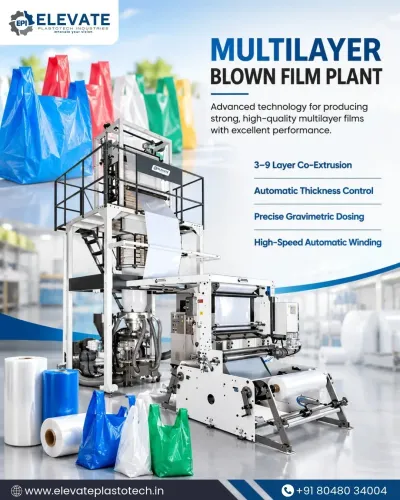
Producing plastic films that meet modern packaging requirements involves careful material selection, consistent processing, and reliable machinery. A Multilayer Blown Film Plant lets manufacturers combine different polymer layers into a single film to achieve specific properties, including flexibility, strength, sealing performance, and moisture protection.
For packaging manufacturers, this technology offers greater control over film design and helps support different production requirements. Elevate Plastotech Industries provides plastic processing machinery solutions to help businesses improve their film manufacturing capabilities.
What Makes a Multilayer Blown Film Plant Different?
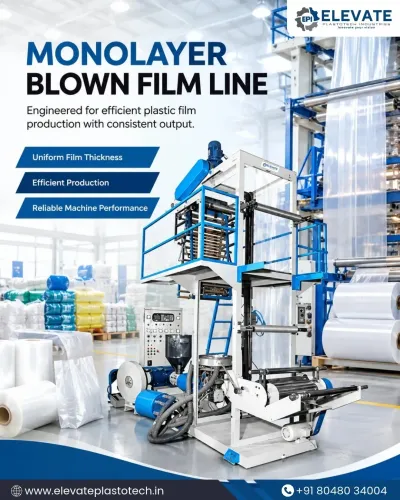
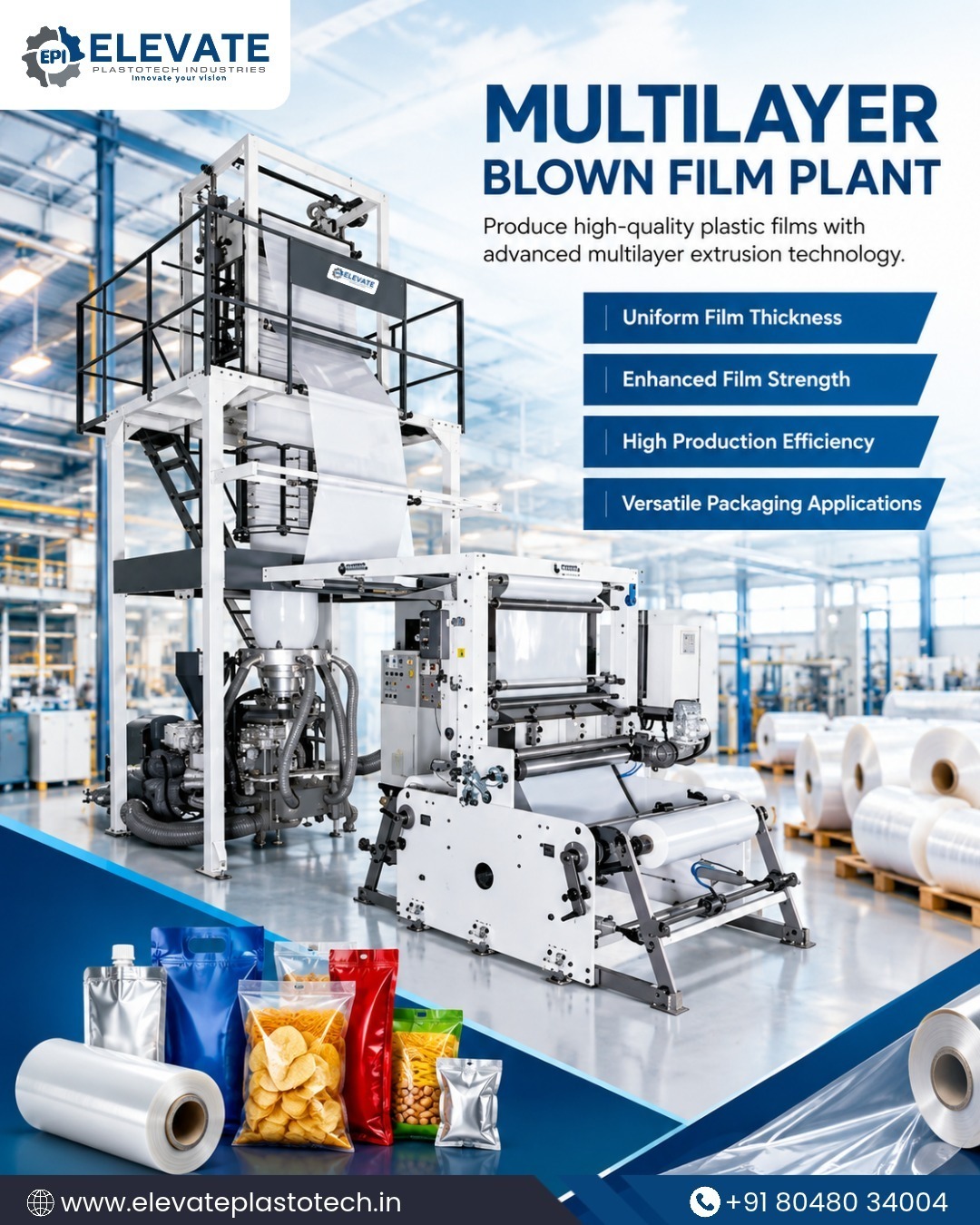
A Multilayer Blown Film Plant produces plastic films by processing compatible polymers through multiple extrusion streams. The molten materials come together in a specially designed die, forming a tubular film that air expands, then cools, flattens, and winds into rolls.
Unlike a single-layer system, a Multilayer Film Extrusion Machine allows manufacturers to assign different functions to individual layers. For example, one layer may provide mechanical strength, while another improves sealing characteristics or contributes to the required barrier performance.
The number of layers, polymer combination, and equipment configuration depend on the final product specifications and intended application.
How Does a Multilayer Blown Film Plant Improve Film Quality?
1. Creates Films with Application-Specific Properties
Different packaging products have different performance requirements. Some need flexibility, while others require greater toughness, reliable seals, or moisture resistance.
A multilayer extrusion system lets manufacturers combine compatible materials to achieve the right balance of properties. This flexibility helps businesses develop films for specific packaging applications rather than relying on a single material to provide every required characteristic.
2. Helps Maintain Consistent Film Thickness
Uneven film thickness can affect product appearance, strength, and material consumption. A properly configured Multilayer Blown Film Plant helps operators regulate extrusion output, cooling, air pressure, and haul-off speed.
When these parameters remain stable, manufacturers can produce films with more uniform dimensions. Routine monitoring and precise adjustments help maintain quality throughout a production run.
3. Supports Better Strength and Sealing Performance
Packaging films must withstand handling, transportation, and storage. Depending on the selected polymers and layer arrangement, multilayer films can be designed to provide suitable tensile strength, puncture resistance, flexibility, and heat-sealing performance.
These properties depend on material compatibility, layer distribution, processing conditions, and the finished product's requirements.
4. Offers Greater Flexibility in Film Design
Manufacturers often supply different film products to meet the needs of various industries. Multilayer extrusion lets manufacturers adjust material combinations and layer proportions to suit specific applications.
This capability supports product development and helps businesses respond to changing customer requirements without treating every film specification as a single-material application.
How Does It Improve Manufacturing Efficiency?
1. Supports Continuous Film Production
Blown film extrusion can run continuously when raw material supply, machine settings, and downstream equipment are managed properly. A well-designed production line helps manufacturers maintain a steady workflow and plan output to meet customer demand.
2. Helps Reduce Material Rejection
Incorrect thickness, unstable film formation, or inconsistent layer distribution can result in rejected products. Effective temperature management, stable extrusion output, and regular quality checks help operators identify process variations early.
Reducing these issues improves material utilization and limits unnecessary production losses.
3. Makes Repeated Production More Manageable
Once operators establish the right operating parameters, they can use documented settings to reproduce similar film specifications across production batches.
Consistent procedures for temperature control, extrusion, cooling, and winding reduce avoidable adjustments and simplify production planning.
4. Accommodates Different Production Requirements
Depending on its design, a Plastic Film Extrusion Machine can support different film widths, thicknesses, and layer combinations. This versatility helps manufacturers serve multiple markets with a production line configured to their needs.
Material changes and product changeovers may still require purging, cleaning, die adjustments, and process testing.
Major Applications of a Multilayer Blown Film Plant
A Multilayer Blown Film Plant can produce films for diverse applications across commercial sectors and industrial operations.
* Flexible packaging: Used to manufacture films for bags, pouches, and wrapping products.
* Food packaging: Supports film structures designed around specified sealing and product-protection requirements.
* Agricultural applications: Used for suitable greenhouse films, crop covers, and other agricultural plastic products.
* Industrial packaging: Produces compatible liners, protective wrapping, and packaging films.
* Carry bags: Supports the manufacture of film materials for different bag applications.
* Protective films: Helps produce films designed to withstand handling and storage conditions.
The final application determines the necessary material combination, thickness, strength, sealing properties, and regulatory requirements.
What Should You Check Before Buying a Multilayer Blown Film Plant?
Choosing machinery based only on its advertised output can overlook important production requirements. Before investing, consider the following points:
* Layer configuration: Determine how many layers your film products need.
* Production capacity: Match the rated output to your expected production volume.
* Film dimensions: Confirm the required film width and thickness range.
* Material compatibility: Verify that the extruders and die can process your intended polymers.
* Process control: Assess temperature regulation, cooling arrangements, and winding controls.
* Power requirements: Review energy consumption under realistic operating conditions.
* Maintenance access: Check routine servicing requirements and spare parts availability.
* Installation requirements: Consider floor space, utilities, ventilation, and material handling.
* Technical assistance: Evaluate installation guidance, operator training, and after-sales support.
Sharing your film specifications and production targets with the machinery provider can help you identify a suitable configuration.
Why Consider Elevate Plastotech Industries?
Elevate Plastotech Industries offers plastic processing machinery solutions for manufacturers exploring blown film extrusion equipment. When evaluating a plant, buyers should compare its technical specifications, production capabilities, supported materials, and suitability for their intended applications.
Businesses looking for a Multilayer Blown Film Plant Manufacturer in Ahmedabad should review machine configuration and performance requirements before buying. Those looking for a Multilayer Blown Film Plant Supplier in Gujarat should also consider installation support, maintenance, and spare-parts availability.
Companies seeking a Multilayer Blown Film Plant Distributor in India can compare equipment specifications, delivery arrangements, documentation, and service coverage to make an informed purchasing decision.
Frequently Asked Questions (FAQs)
1. What is the main purpose of a Multilayer Blown Film Plant?
Its primary purpose is to manufacture plastic films containing multiple layers of compatible materials. These films are used in packaging, agriculture, industrial liners, and other applications that require specific combinations of material properties.
2. How does multilayer extrusion improve plastic film quality?
It lets manufacturers combine materials with different characteristics into a single film structure. Depending on the materials used, the finished film can balance strength, flexibility, sealing performance, and barrier properties.
3. Which raw materials are used in a Multilayer Blown Film Plant?
Common materials may include LDPE, LLDPE, and HDPE. Other compatible polymers may also be used depending on the plant configuration and the intended film application.
Keywords