Multilayer Blown Film Plant: Advanced Film Production for Modern Industries
Plastic film manufacturing has become increasingly demanding. Manufacturers today need films that are uniform and reliable and deliver strength, puncture resistance, and barrier performance for specific applications. Producing such films efficiently requires the right extrusion technology and precise control at every stage.
A Multilayer Blown Film Plant provides a practical solution by combining multiple polymer layers into a single film structure. With advanced co-extrusion technology, manufacturers can create films with different properties across layers while maintaining a consistent, functional final product.
Elevate Plastotech Industries offers multilayer blown film technology for manufacturers seeking high-performance films with improved quality and production flexibility.
What Is a Multilayer Blown Film Plant?
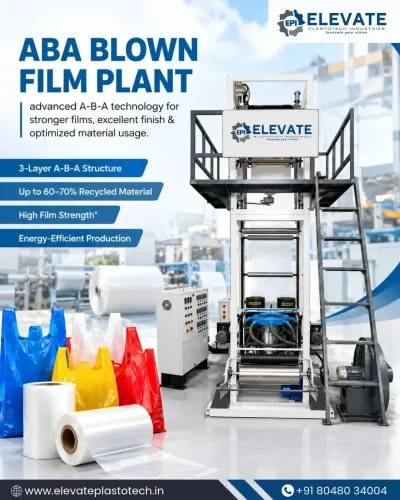
A Multilayer Blown Film Plant is an extrusion system that produces plastic films by combining multiple polymer layers through co-extrusion. Instead of producing a film from one material, the machine can combine different materials or formulations into a single multilayer structure.
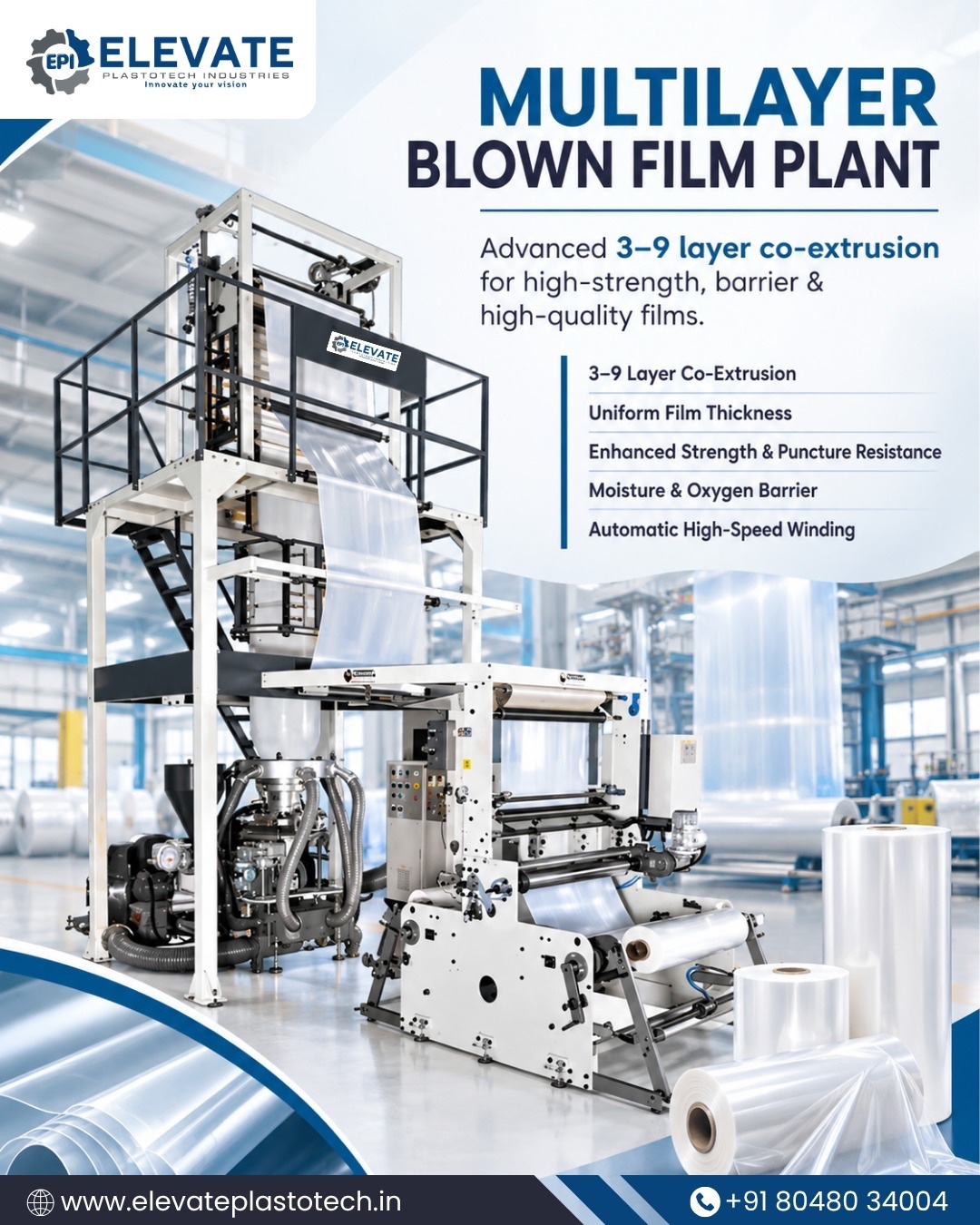
The image highlights a 3–9 layer co-extrusion configuration. This lets manufacturers engineer films to meet the requirements of their final application.
Different layers can contribute different characteristics, such as strength, flexibility, sealing performance, or barrier protection. This makes multilayer technology especially useful when a single material cannot provide every required property.
Understanding 3–9 Layer Co-Extrusion
The number of layers plays an important role in film design. A 3–9 layer co-extrusion system gives manufacturers greater flexibility when developing films for specialized applications.
For example, one layer may provide mechanical strength, another may provide moisture or oxygen resistance, and another may be selected for sealing or processing characteristics.
This layered approach lets manufacturers optimize material use while developing films with a combination of properties that would be difficult to achieve with a single-layer structure.
Why Uniform Film Thickness Matters
Consistency is one of the most important factors in plastic film production. Variations in film thickness can affect strength, appearance, sealing, and downstream converting processes.
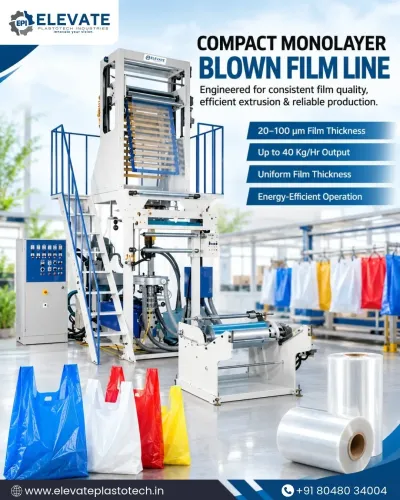
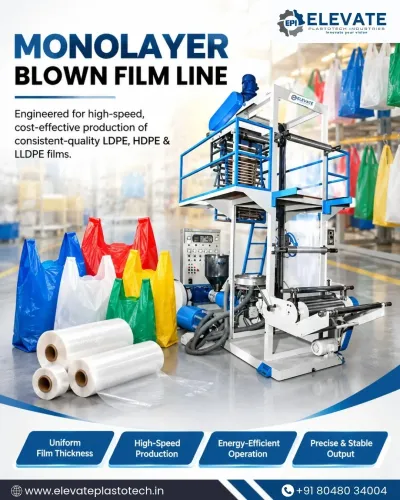
A modern Blown Film Machine is designed to maintain controlled extrusion and film formation so the final material achieves more uniform thickness.
Better thickness consistency can help manufacturers reduce material variation and maintain predictable performance across rolls. For industries producing films at commercial scale, this consistency becomes especially important during printing, lamination, bag making, and packaging operations.
Enhanced Strength and Puncture Resistance
Packaging films often need to withstand handling, transportation, and storage without tearing easily. A multilayer structure helps manufacturers combine different material characteristics in one film.
By carefully selecting the composition of individual layers, manufacturers can develop films with enhanced mechanical properties, including improved strength and puncture resistance.
This is especially useful for packaging applications where the film must protect its contents while remaining lightweight and flexible.
Moisture and Oxygen Barrier Performance
Packaging isn’t only about physical protection. In many applications, the film also needs to help protect products from environmental exposure.
Moisture and oxygen can affect the quality and shelf life of certain packaged products. Multilayer structures let manufacturers incorporate materials selected specifically for barrier performance.
A properly designed multilayer film can therefore combine structural strength with barrier properties, creating a more functional packaging solution.
Automatic High-Speed Winding
Film quality needs to be supported by efficient production and winding. Once the film has been formed and cooled, it needs to be collected into rolls with appropriate tension and alignment.
The automatic high-speed winding capability highlighted in Elevate Plastotech Industries’ machine can support continuous production while helping maintain organized film rolls.
Automated winding can also reduce repetitive manual intervention and streamline the production workflow.
Applications of Multilayer Blown Films
Multilayer films are used across several industries because different applications require different combinations of properties.
Common applications can include:
- Flexible packaging
- Industrial packaging
- Food packaging
- Agricultural films
- Protective packaging
- Laminating films
- Shopping and packaging bags
- Specialty barrier films
The exact application depends on the polymer combination, number of layers, film specifications, and required performance characteristics.
Key Benefits of the Multilayer Blown Film Plant
For manufacturers, the major advantages of multilayer blown film technology include:
Flexible Film Design
Multiple layers allow manufacturers to combine different material properties in one film.
Consistent Production
Controlled extrusion helps support uniform film thickness and repeatable output.
Improved Strength
Multilayer structures can be engineered to provide better mechanical performance.
Barrier Properties
Specific layers can contribute to moisture and oxygen barrier requirements.
Production Efficiency
Automatic winding and high-speed operation can support continuous industrial production.
Application Versatility
The technology can be configured for different film types and end-use requirements.
What to Consider Before Choosing a Blown Film Plant
Selecting a film extrusion system should start with the intended product rather than focusing only on machine capacity. Manufacturers should consider the required number of layers, film width, thickness range, polymer combinations, production speed, and desired barrier or mechanical properties.
It is also important to consider downstream requirements such as printing, lamination, slitting, and bag conversion. The film plant should complement the complete production workflow.
Evaluate technical support, machine configuration, and operator requirements before installation.
Elevate Plastotech Industries: Supporting Advanced Film Production
Modern film manufacturing requires a balance of quality, flexibility, and production efficiency. A well-designed Multilayer Blown Film Plant helps manufacturers achieve that balance by combining multiple material properties in a controlled extrusion process.
With 3–9 layer co-extrusion, uniform film thickness, enhanced strength, barrier performance, and automatic high-speed winding, Elevate Plastotech Industries’ solution is designed for manufacturers producing technically capable films for demanding applications.
For businesses planning to expand their film production capabilities, multilayer blown film technology offers a flexible platform for developing films suited to changing market and packaging requirements.
Frequently Asked Questions
1. What is a 3–9 layer blown film plant used for?
A 3–9 layer blown film plant manufactures multilayer plastic films by combining several polymer layers in one extrusion process. Each layer can be designed to contribute specific properties such as strength, sealing performance, or barrier protection.
2. What are the advantages of multilayer blown film over single-layer film?
Multilayer film allows manufacturers to combine different material characteristics in one structure. Depending on the formulation, it can provide improved strength, puncture resistance, moisture or oxygen barrier performance, and greater flexibility in designing films for specific applications.
Keywords